Showing posts with label France. Show all posts

Sunday, 29 November 2015

History Sunday: Anniversary of the White Ship disaster

I always miss anniversaries of historical dates, I'm either a day late, or in this case almost a week.  I just happened upon this one and decided it wasn't too late to write a post (my first one in a while).

William Adelin, Duke of Normandy, isn't a common household name, is it?  Unlike Richard III, Edward Longshanks,Thomas Becket, he's barely a footnote in history books.  He deserves more of a place in history considering it was his death that began the infamous Plantagenet dynasty in England.

William Adelin was the eldest, and only, son of King Henry I of England, and his first wife Edith (Matilda) of Scotland.  Looking back through the patrilineal side, William's grandfather was William the Conqueror (part I, part II, part III), Duke of Normandy and first Norman King of England, and his grandmother was Matilda of Flanders.  Through his mother, Edith of Scotland, his grandfather was King Malcolm III of Scotland, and grandmother Saint Margaret of Wessex.  Some confusion with his mother's name, she was christened Edith (an Anglo-Saxon name), however when she became Queen of England she changed it to Matilda, however I prefer referring to her as Edith because she was Scottish, and there are far too many Matilda's in this era.  All in all, William Adelin has some lineage going for him.

He became Duke of Normandy (ish) in 1120 because his father was a little too proud to do homage to the King of France for Normandy, and so sent his son.  This all sounds very familiar, doesn't it?  Henry I is certainly not the last king to send his son to France for this reason.

It can safely be said that William Adelin was the future of England and Normandy for the period he was alive, as the heir of Henry I.  We can only imagine what the father's expectations for his son were, or those of the nobles and normal folks'.  However, they were never to be lived up to.

Now, my cultured friends, many of you will know what the White Ship disaster is considering you've found this blog post, however for those of you who are simply curious wanderers I'll briefly explain.

The White Ship disaster is one of those important moments in the history of England from which there spilled lots of "what ifs".  The year is 1120, Henry I is sitting comfortably on the throne of England, he and his only son and heir are across the sea in Normandy.  Wanting to test out a new ship, the guilty "white ship" of the title, it's offered to the King, who refuses and instead passes it to his son.  The young heir to the throne, along with a handful of Henry I's illegitimate children, plus a good few hundred people, march onto the ship and both set sail from Barfleur in Normandy, heading to England.  Only one party would arrive.

The white ship sunk, leaving only two survivors, and William Adelin, only son of King Henry I, was not one of them,

The rest is a very dark, cold, corrupt part of history, known aptly as the Anarchy.

The white ship disaster has the potential to spark a multitude of different what if scenarios.  What if William had survived?  What sort of king would he have made?  How would the rest of the history of England have gone?  What would an England without the Plantagenet dynasty at the head have looked like?

Probably quite dull.

I am joking, but you can't say the Plantagenet family didn't know how to kick up turmoil.

Getting back to it.....William Adelin was only 17 when he perished in the Channel with his wife.  As he was so young, and had almost no power in his own lifetime, he's been mostly forgotten by history except as a footnote at the beginning of the Anarchy.  I couldn't really find that much about Adelin, save from reading before he got in a lifeboat he went to fetch his illegitimate sister, and by doing this killed pretty much everyone in said lifeboat by overfilling it.  If it's true, at least we know he's wasn't selfish.

It's all well and good making what if scenarios about history, but the nature of the beast is to be chaotic and messy, even when there is an obvious heir.  If Adelin hadn't perished, and become King of England something else would have happened.  A war between him and his cousin William Clito for the throne, or for Normandy?  His sons would have rebelled, died, something else.  If one remarkable thing hadn't happened, then something else would.  No king's reign in England was not marked by some important date.

Unfortunately, for William, the important date in his life to be contributed to history was his death.

I've read a few fiction novels about the 12th century, mostly because I'm obsessed with Henry II, who would never have became king if Adelin had survived. Just imagine, a red haired, energetic, intelligent man amounting to a measly Count of Anjou, forgotten by most.  What a waste.

Thankfully history was on Henry's side, however it certainly did no favours for the innocent people of England between the grandfather's death and the grandson's ascension.  From what I can imagine, and what history tells us in the famous quote:

"Christ and his Saints slept"

We can only have nightmares about what the anarchy was actually like for people living through it.  I don't know who had it worse, noble men and women who had to decide which horse to place their bets on, or the ordinary folk who were caught up in something that they probably didn't care much for.  Do you care who's Queen of England?  Does it affect you in any way?  I can't imagine it affected the people working the land much either, but maybe that's the ignorant part of my speaking.

The Anarchy all ended in Henry of Anjou, Matilda of England's eldest son, and Henry I's grandson, becoming King of England, hence beginning one of the most tumultuous dynasties in English history, the Plantagenets as they're known now, but that's another story.

And that brings to end this modest post about a very interesting figure of English history, one of the only few who's "what ifs" could have changed English history.  William Adelin, Duke of Normandy, only son and heir of Henry I of England.

Sunday, 8 February 2015

History Sunday: A brief history of corsets

I started making a 19th century corset this week, or last week, which according to the pattern dates from 1837-1890 give or take.  When everyone thinks of corsets the 19th century automatically comes to mind, women deforming their bodies from a young age by cinching the corset cord a little tighter, some women wearing them whilst sleeping, and even maternity corsets.  It's something that brings to mind the fashion plates with the ridiculously tiny waisted women; something perhaps of oppression?  Funny how one piece of clothing history has so many connotations.

My opinion on the matter; women chose to wear them, just as women choose to wear bras nowadays; one creates a desirable small waist, the other enhances our nature given assets, but at the end of the day it's a personal choice.  Despite common thoughts on corsets, they date further back than the 19th century, a lot further back.

First of all let's start with its name.  The word corset is actually a relatively modern word to refer to these pieces of underwear.  The original names, taken from household accounts and primary sources, are "a pair of bodies" (think this came from Queen Elizabeth I's wardrobe account).  The word I use when I'm writing historical fiction is "a pair of stays".  This was what they were referred to as throughout the 18th and 19th centuries, the height of their use.

A proper "pair of bodies", i.e a piece of underwear that created a fashionable silhouette, was recorded for the first time in English during the reign of Elizabeth I.  If you look at her funeral effigy (she died in 1603) it has an early corset on it that creates a conical silhouette, very popular at the time.

They became so popular that almost every women wore one under her garments.  It fascinates me that today women still have "ideal" body shapes.  It's still the hourglass isn't it, I'm a bit out of touch.  Not so for our Elizabethean ancestors who liked looking conical.  Farthingales (the ancestor of the infamous crinolines) were worn under skirts during this period to create a cone like skirt, and the torso was an inverted cone.  What on earth made women want to look like that?  I'll never know.  But it accentuates the waist, a trait which is till desirable today.  A modern reproduction of a 16th century pair of bodies is pictured on the left.
Bodice from 1660-


Moving into the next century, the 17th.  I'm afraid these corsets, and the 18th century ones, are my favourite, mostly because of what they do to the chestal area.  Be prepared for a post that is beginning to feel like boob porn.  These corsets still gave the conical shape fashionable in the previous century, but the dresses were now becoming very low cut so as to accentuate what the conical corset did to the not so angular breasts; it pushed them up.  This change in fashion obviously happened after the Restoration in England, which happened in 1660.  Thomas Cromwell would never have allowed women to go around with their assets peeping over the top of their clothes.  I only know about British fashion at this point, so I do apologise.


You can of course buy reproductions of corsets from these time periods.  The one pictured on the left is made by a wonderful Etsy shop Period Corsets (click on the link to take you to the corset pictured).  This lovely lady also does 18th, and 19th century corsets, petticoats, and most other undergarments, so please do go and check her shop out.  My favourite is the one pictured, from circa 1660.  You can get in in a beautiful brocade as well.

Another mention to the amazingly talented lady who is the owner of the Before the Automobile Blog.  She does hand sewn historical reproductions ranging from the 17th century to the 19th, and if you have time, or haven't heard of her, do go to her blog.  I'm a major fangirl of hers.  I'd like to thank her, and apologise for stealing her pictures for the purpose of this blog.

As you can see there are tabs at the bottom, and it surprised me to find that the bones in the corset actually extend to these tabs.  The reason they're reinforced is because of the weight of the skirts, and in the next century those awful panniers.  Under the skirt is a "bumroll", or a cushion that makes your ar*e look bigger.  I'm actually undecided about these, I think it depends on the size.  Anyway, the tabs are for supportive purposes, because on top of this bumroll are many petticoats, and of course the actual dress, so you can imagine the weight.

Now we move quickly onto the 18th century, and...those......panniers (grrrr).  As you can no doubt tell these are my least favourite fashion, in history!  The second is the strange circular skirts of the late Elizabethean period.  What on earth possessed women to wear panniers?  I don't mind the smaller panniers, but the court ones were just ridiculous.
Pictured on the left is the wedding gown of Hedwig Elizabeth Charlotte of Holstein-Gottorp, Queen of Sweden.  It has a train (can't find the picture now) that just looks like a roll of fabric attached to her skirt.  Any beauty in this dress is ruined by the panniers, in my opinion.

Before the automobile
But this post is about corsets.  The shape of the corset actually changes at the top.  Rather than the gradual curved top of the 17th century, the front of the 18th century corset takes another dip down near the chest.  More of a ladies' assets revealed!

The tabs are there again, boned and finished, in order to support those God awful panniers.  From this period, I've found, you can get half-boned, and fully-boned.  The type of boning used in those days was whalebone, which you can't get anymore.  No busks in the front, although they were used in Elizabethean corsets they aren't used for these centuries.  As with laced clothes, laced stays could either have front fastenings or back fastenings.  Who used which?  Not hard to guess really, those with enough money for maids would have back fastening, those who didn't would have front fastenings.  For a costumer, I recommend the front fastening, unless you always want help to dress, because I had this problem with my kirtle.

I have a pattern for this type of corset that I bought because it was on sale.  There's options for back and front fastening, but I know which one I'll go for when the time comes to make it.  To be honest I only like the late 18th century fashion because the panniers thankfully disappear, but unfortunately by that time you're into Empire waists and gored corsets instead.  Maybe one day I'll make an outfit from this time, but not currently.

Short stays
Now we're onto a completely different style of stays.  All of a sudden fashion moved away from conical shapes, and stupid panniers, and moved to the Empire Waist of ancient Greece.  Everything became gentle, simple, and elegant.  There are two types of corset that are from this period; long stays, and short stays.

Long stay
From their name, and from the picture, this is the ancestor of the modern day "corselette": is that what you call them? I've seen them in the lingerie section of shops but I can't remember their name.
Regency undergarments
Long stays extend all the way down the body, like the later 19th century corsets, and was used for extra shape; some women have a tummy.  The one pictured on the right is from another great Etsy shop that makes 19th century corsets, other supplies, and corsets from other periods, for women of all sizes.

These corsets have bust gores, and waist gores, I think they're called.  As with the gores on a medieval kirtle, these are triangular pieces of material inserted to accommodate a wide hem.  The gores on the bust are supportive, rather than the push up function of previous centuries.  Watch regency period dramas; more amazing cleavages!

The undergarments, pictured left, are courtesy of another blogger, Diary of a Mantua Maker, check out her blog as well.

Now we move onto the masses, and masses, of victorian corsets.  The pattern I have, laughing moon Dore Corset and Silverado corset, circa 1837-1900.  My choice was the silverado which has bust gores, the Dore doesn't.  After I cut it out, etc, I was worried that this type of corset wasn't used for my period (which was 1900, but I'll get to that later).  I looked at other patterns, taken from originals, and some originals, and some corsets have bust gores throughout the 19th century, others don't.  So I've reconciled myself to the bust gores.

I am aware that by 1900 the horrible front corset had come into fashion, rather than an hourglass silhouette, it was fashionable to look as if your head was too heavy for your body and it was dragging you down at the front.  I know it isn't technically historically accurate to make a 1900 outfit with a Victorian corset, but I hate, hate, hate that Edwardian corset.

The busk is back, and changed.  The busk during the Elizabethean period, was a flat piece of whalebone or wood that stiffened the front, now it's changed into a device for easily opening and closing the corset on your own.  As of today I've already inserted this, thankfully the right way.

This corset cinched in the waist and created that fashionable hourglass figure.  There were different
lengths, short, long; different types, underbust, overbust, mid-bust.  Most of which have been adapted by the steampunkers out there for modern wear.

Hopefully my own experiences with making a 19th century corset will be posted soon; I'm sewing it all by hand, which is more difficult than I had imagined.  I already have the busk inserted, and I'm currently working on the back pieces now with my new grommet inserter (I did it with a hammer before).

Sunday, 25 January 2015

History Sunday: Joseon Dynasty

I can guess the reactions of people who stumble on this accidentally.....whaaat?  To those of you people that do know what this is, welcome, please feel free to look around one of the most random blogs you'll ever read.

I don't think I've ever mentioned on this blog but I am a big fan of South Korea.   It all started......well, that doesn't matter, but the love for that part of the world has been a long lived one.
South and North Korea as we in the West know it today is from the modern era and came about in the 1950s.  Before this both the North and the South were known was Joseon (Choseon, Chosun, there are different variations because there's a few anglicized versions of Korean).  The most common way of spelling it is Chosun, but in subtitles it's always Joseon and I prefer that.

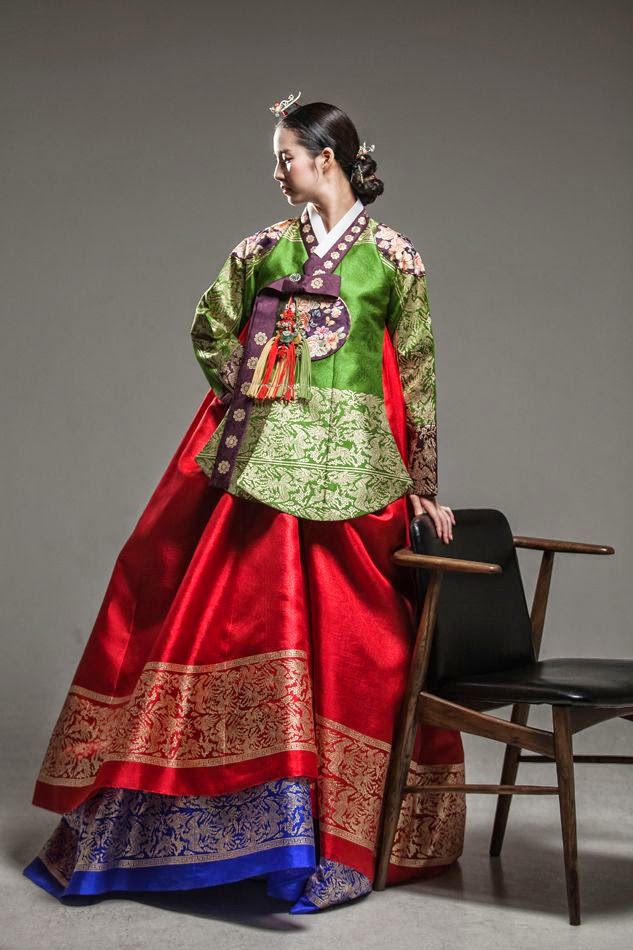
Court Hanbok
The Joseon dynasty of Korea was founded in 1392 and lasted a whopping 5 centuries until 1897.  The really interesting thing about Joseon is that there was very few changes to anything during this period.  Obviously technology toddled along, but because of the strong trade links with what we now know as China everything had to really come through them first.  By few changes I meant social changes, which is always the thing I'm most interested in.
Typical male attire

The whole topic of Joseon is a large one, many kings, many politicians and nobles, some Manchu invasions.  I always find that the history of this part of the world is completely unknown to those in the West and explaining it would be a massive undertaking.  Instead, because my writing research has taken me to this period I'm going to attempt a brief explanation of the fall of Joseon and the aged culture that met with the rapidly growing 19th century.

Joseon was a "hermit kingdom" as one British newspaper called it.  Closed off for centuries, no foreign body, at least western foreign body, had been allowed in for about two hundred years.  As everyone does know during the 19th century the west really met the east of the world for the first time in history, and what a mess it was.  China seemed to have a better time of it than a many other places, but I say that because I'm ignorant.  There doesn't really seem to be a set time period when West met China, quite unlike the 1860s when West met Japan, and 1860-1870s when West met Joseon.
Imjeongjeon Hall,
Changdeok-gung (palace), Seoul

I always cringe when I watch movies like The Last Samurai because the Americans and the British were just so arrogant to Eastern cultures.  It mirrors when the Normans invaded England during the 11th century, arrogance and superior attitudes tried to stamp out the Anglo-Saxon way of life.  To be fair to the Normans the Anglo-Saxons weren't that different, they dressed slightly differently, spoke a different language, but they were at least recognisable, and the cultures weren't that different thanks to Christianity.  As everyone knows, and not to be racist, Koreans, Japanese and Chinese all look different from westerners.

Yangban
If that wasn't enough, the culture was radically different.  There was a caste system implemented in Joseon that had sustained for its 500 year existence, and even before that.  The top tier was the King (Wang), he had an absolute rule over the country, but he had a cabinet, or government body that were created to "guide the king on a wise path" and were allowed to disagree with him when they thought his decisions weren't for the best.  These men, and a few others besides, were called yangban, which roughly translates to nobles.  They were a class in themselves, and yangban status extended for three generations, or was gained by those who passed certain examinations of government.


Throne room, Changdeok-gung,
Seoul
I won't bother discussing the complexity of the Joseon government hierarchy; it's made up of  Senior and Junior ranks, numbered 1-9, and departments (I think there were about seven or eight main ones) where these officers worked.


To give you some perspective, not that you may need any, this yangban class only accounted for 10% of the entire population.  Not really that shocking when this is the same in every country in history.  What was perhaps most shocking for our 19th century ancestors was slavery.  Slaves in western countries were captives from Africa and southern places, their skin colour was darker than westerners, but Korean slaves were the same as their so called betters in every other way apart from the place in society where they were born.  Slave status was hereditary, it was used as a punishment also for yangban who had broken the law (and been caught).  It is thought that a whopping 30-40% of the population were slaves.  Don't think I mean anything different by slavery either, these people were objects, bought and sold, inherited, given away, you name it, slavery in its most basic form.  I don't mean to sound so disapproving here but it's hard not to.

The rest of the population either fell into: Sangmin, where most people fell.  This was the population, normal people who worked for a living; fishing, farming, etc.
Cheonmin status is the lowest and where the slaves were taken from sometimes, and these people usually worked in "unclean" professions, like butchers and prostitutes (Kisaengs).
typical kisaeng attire
Chungin, which I come to understand as the equivalent of Victorian "middle class".  Professionals that had made something of themselves, but were considered by upper class as being "in trade".  This was probably the least populated class.

This culture had lasted for centuries, but it took less than two decades from Joseon opening its ports to western trading for it all to collapse, probably for the better.  Unfortunately, as with every big change in history, erasing the caste system meant other radical change, and as a result Joseon lost its royal family and much of its identity until mid-20th century due to Japanese occupation of Korea.  I won't go into that here because it feels to me as though it's still a bit of a sensitive area.  All I will say is that I shudder when I read about what the Japanese did to the Koreans at the beginning of the 20th century.
traditional Hanbok

This has been a very long post and I'm not really done yet, but I promise it won't be long now.  My research focuses on 1880s Joseon when trade and foreigners were just beginning to be allowed back in after a 200 year ban.  My interest lies in what it was like for these first foreigners to enter into a country so closed off from most of the world.  There were a few rebellions and insurrections during the 1880s mostly because of the influx of foreigners and unfair treaties Joseon was making with Japan.  Who went to Joseon during this tumultuous time?  Merchants, diplomats?  Did their families go with them?

And what was it like to be Korean during this time of rapid change?  Was it unsettling to see a western face so unlike your own amongst the Korean ones?  Were they scared of foreigners, angry at them, suspicious of them?  It's hard to know what average Joe thought since most of the population were illiterate.


The tale my research is forming the base for is set in the 21st Century as well and I'm curious to find how many things have changed since the 1880s?  Do you still get stared at?  Is there still suspicion of you as a foreigner?  Obviously the culture has changed a little since the 19th century, but with the greatest respect to the Koreans, it has managed to endure nearly a century of hardship.  I love the Korean culture, I think it's awesome.  It'll be interesting to see where this tale takes me, but seeing as I'm trying to juggle two others at this point I think it will have to incubate for a while.


Sunday, 11 January 2015

History Sunday: a brief overview of 11th-14thC fashion

I was stumped on what to do for the first History Sunday of 2015.  I'll admit that sewing 19 hand sewn eyelets onto the closure of my kirtle was inspiration (and also why I wanted to write a quick post with minimal research).  It's only in recent years that I've become interested in historic fashion, and there are outfits I've seen that survive or that I like that I add a note in my mind that one day I'd like to make one.  The only historic clothing I have under my belt is one very non-period accurate sideless surcote in cheap purple satin (yes, that's right, satin), my semi-accurate 15th Century Italian gown, and now my 12-14th Century gown based on Waterhouse's The Tempest which is perhaps a week or two from being completed depending on how much time I get this week to sew it.

I'll begin in the obscure-ish 11th century.
Pre-Norman conquest fashion is a bit of a grey area for me as there isn't much artwork or sources that survive from the period.  This was made apparent to me when I was researching for one of my series of short stories set in post-conquest England.  From what I could pick up it seems as though fashion is a very liberal word because there wasn't really any.  Things like buttons, hooks, clips, etc, hadn't come into use then and so the only thing to fit clothes to the form was belts usually placed at the waist.
There was a shift, sark, chemise, there have been a lot of names for them over the centuries and I don't know the 11th century word for it, and that was usually made of linen, homespun for the lower rungs of society.  Over this would be a kirtle, what I'm currently busting my ba**s to make.  Colours were also different during this time, they would be drawn from natural sources, some would be imported and only available to the rich, so none of your cobalt blue or cerise pink.  I have seen a few pictures an sources of a sort of tunic over this, a little shorter than the kirtle, with loose sleeves (but not the ridiculous ones of decades later that the Normans brought over).  As well as materials and fabrics being a sign of status, colours were also, as well as layers.  Personally (maybe even factually) I think this draws from previous centuries where layers meant status because fabric was expensive and the more you clad yourself in, the richer you were.

Now come the Normans and the age of the famous bliaut which has been the inspiration for many a medieval fantasy movie costume (I'm looking at you Lord of the Rings, and Game of Thrones). I'm afraid the bliaut actually edges more into the 12th Century than the 11th, but the Normans wore tight fitting clothes which the Anglo-Saxons didn't (reportedly).

Apparently Norman women just liked excessively long everything because this was also the time when the really long plaited/wrapped hair came into fashion.  As with women all throughout the centuries to keep up with the trend those who couldn't grow their hair the desired length would add ornaments to the ends of the braids to lengthen them, or wear what we would call extensions today.  I really like the series of drawings pictured on the right, I can't remember who drew them but on behalf of all history clothing buffs I would like to thank you.
These bliauts were not as tight fitting as some other dresses would become through the centuries and so women belted it, usually twice wrapped around, like the lovely lady pictured right.

Moving on nearly a century we come to the rather obscure 13th century.  I don't know why it's obscure but people don't seem to make many clothes from this time period, at least not what I could find when I was researching.  What I could conclude was the drawing pictured on the left.
Gone are the wrapped belts.  Sleeves are tight fitting, and over it is what I assume to be the very early ancestor of what would later become the sideless surcote.  Long, bared hair came into fashion (I wonder what the church felt about that) worn with a barbette and fillet (different spellings of those).  I've sometimes seen this referred to as a pie crust which I love.  This will be the early 13th century because by the end of the 1200s the sideless surcote was popular in Europe.

Finally coming to the 14th Century, and the one I hope I know the most about.  The sideless surcote, or fondly nicknamed by the church as "Gates to Hell", was a staple fashion of this century.  It was called by this loving name because it showed off the figure of the wearer, which of course the sexually oppressed church members thought was a "temptation into sin".  They should count small blessings, hair was once more covered during this period by the templars.
Phillipa on the right
In my opinion the church should have been more against buttons which came into use during this period.  After making 24 fabric buttons, 24 handstitched button holes, and soon-to-be 38 eyelets I wonder at the trouble women went through to make tight fitting clothes.
Now that women could be laced, or buttoned, into their garments a whole new medieval version of "on show" came into being.  Buttons were common as the closure of garments but also on the sleeves (and don't I know it) to make them as tight fitting as possible as well.  Over which could be the sideless surcote.
Another fashion in this period was tippets, pictured again on the right.  These are usually pictured as white so probably made of linen and were attached to the sleeves and just kind of..hung there.  I personally don't know the point of these so if anyone could inform me that would be great.

14th century territory would be the Burgundian gowns and the emergence of high/empire waisted garments, but that's beyond this post.  I feel as if I've butchered this whole topic by being so brief but I never have been a very detailed person.  Hope for a better organised History Sunday next week, and to end this post a pretty peacock from an illuminated manuscript that I've been waiting to use, so yay!

Sunday, 14 December 2014

History Sunday: William the Conqueror, Duke of Normandy (III)

Welcome to the third and final post about William the Conqueror, the first Norman King of England.  So you don't get confused here is part I, and part II.

Before I go into many, many paragraphs about William's battle prowess and his take-over of England I want to talk about his appearance.  We're actually very lucky in that there were a few contemporary descriptions of him, and the only bone of his not to be lost to the ravages of time, his femur, has been examined using modern techniques.  Another side note here the first King of England to actually sit for a portrait was the infamous Richard II who I've briefly mentioned in my John of Gaunt posts.  His reign was during the 14th century, so during our period in the 11th it just wasn't the done thing.  The only images to survive of people during this time, kings and queens usually, are coins, seals or illuminated manuscripts.  I'm actually surprised I haven't had room to mention the Bayeux tapestry in this series of posts because in my mind you can't think about William I without it.  Unfortunately seals, coins and the tapestry aren't likenesses of a historic figure, usually just a generic one.

From contemporary sources it is said that William was well-built, strong, and had a guttural voice.  From his femur his height is estimated to be about 5 feet 10 inches.  According to a source this was tall for the time but I respectfully disagree with this.  It is a common misconception that our ancestors ere smaller than us, but studies that I've read and other sources I've browsed show that there isn't actually much of  difference between the average height in previous centuries and now.  I think women have grown an inch perhaps, and men are close to that.  It is above average height, regardless.  Unfortunately there is no colour descriptions, his eyes or his hair, but I think it's most probable, given his northern European lineage, that he had dark hair and possibly light-ish eyes, I'm not going to venture a colour.

Now the Bayeux tapestry.
No one knows who comissioned this, there's debate about where it was even created.  I think Odo of Bayeux, and William's wife Matilda are the most popular contenders for the comissioners; I've heard somewhere that it may not have been made in Bayeux at all but in England because English women were famed for their needle skill.  Because it was found in Bayeux I think people will naturally assume that Odo of Bayeux, William's half-brother and the Bishop of Bayeux, was the one who ordered it to be made; unfortunately it's a mystery.  To see a video of the Bayeux tapestry click here.

To understand why William wanted or rather stole, the crown of England we first have to look firstly at the validity of his claim, and secondly the precarious situation in England at the time.
Edward the Confessor
William's great-grandfather, Richard I of Normandy, had two children; Richard II and Emma.  Emma married Aethelred the Unready, King of England and had Edward the Confessor.  England at that time was not the England we know today, half of it was England, the other half now known as the Danelaw where the viking settlers remained.  Cnut, the King of the Danelaw, managed to conquer England and this sent Edward the Confessor, and his younger brother, into exile in Normandy.  Things happened in England that I'm not all that knowledgeable on the details but eventually, as we know, Edward claimed back his throne and became King of England.
Edward never married, and is the only English King to become a Saint.  I don't understand why he never married, especially when during later periods so much focus was placed on producing an heir.  Perhaps it was because of his struggles with the Godwin family, the powerful Earls of Wessex, I'll never know.  No one knows what he intended about the succession because there were many candidates.

William claimed that he had been promised the throne of England by Edward himself, and that he was always supposed to be his heir, but there has never been any proof of this found in any sources.  I don't know if it's true or not, but from what we've seen of William's ferocity and ambition I think he saw an opportunity and took it.  Edward the Confessor died sometime in January 1066, and so started the events that would change English history.
Harold Godwinson claiming the throne

There are a lot of details surrounding the Norman invasion, ones I have tried to read during research for a series of short stories of mine set in England in 1072.  I'm not going to recount them here, only in brief.  After Edward's death Harold Godwinson, Earl of Wessex, claimed the throne for himself.  This apparently enraged William who thought he was the rightful heir.

Having fought all of his life to win control over Normandy, William gathered a great force and set sail for England after a delay crossing the channel due to bad weather.

Eventually he landed in Pevensey in September of 1066 with an army and a determination that no man could withstand.  By October of the same year he had defeated Harold at the never to be forgotten Battle of Hastings and claimed England for himself, becoming one of the most powerful men in 11th century Europe.

Oh dear, if only it were that easy.  People usually leave this story at the Battle of Hastings but wars are rarely one during one battle.  This is the thing, it's in the name, the Norman conquest of England.  Anglo-Saxons were the inhabitants of England during this time, they spoke a variant of old english, Normans spoke Norman French.  This would literally be like French people coming over to England now and taking over,; your boss is French, he demands and expects you to be fluent in French as well, he's going to change the way things work, the law, to the French laws.  That's not particularly true in this case, Anglo-Saxon law was well developed, even better than the Norman one, and so for the most part William changed nothing like that.  What he did do was pull down prominent Anglo-Saxon magnates and nobles and replaced them with his Norman followers.  This enraged the populace and for many years following Williams coronation he had to fight remnants of the Anglo-Saxon nobility.

The most pungent of these events, for me, was the harrying of the north.  This was literally destruction on a mass scale, ethnic cleansing if you will.  William marched an army to York and then ravaged everything north of that point, burning villages, towns, killing people; it certainly sent a very loud message to the rest of England but it was brutality on an awful scale.  Although I admire William I loathe him for this; mass punishment for only a few perpetrators is illogical and barbaric.

Unfortunately even up until the end of William's life he faced opposition from the Anglo-Saxons. It didn't help any that he commissioned the Domesday book in 1085/1086 that recorded everything he owned in England, every property, every village, town, home, castle, etc.  Although it was despised at the time it has now become an invaluable resource about the geography of England, and the history of the largest cities and towns.

William died in 1087 probably from a fall from his horse although it's a bit unclear what actually happened.  He wasn't a very respected king because as soon as his last breath had left him everyone scurried away to prepare for the aftermath his death would bring, and when his body was eventually found most of the things in his residence were stolen by servants and his body was lying naked on the floor.  I act shocked about things like these but it also happened to Henry II as well.

Slowly after his death the great empire he had clawed and scraped together disintegrated until roughly 1100 when Henry I managed to regain most of it.  He left England to his son William Rufus, and Normandy to his eldest son, and possibly most disliked, Robert.  Over the remaining decades until Henry I's reign the brothers bickered terribly for control over the other's domain, until eventually the youngest son, Henry, became eventual heir to William's empire.

Queen Elizabeth II, the current monarch, is descended from William, as are many other people around the world.  He brought Norman French, which merged over hundreds of years with Anglo-Saxon to give our modern day English.  Beef is actually a Norman word, cow is Anglo-Saxon.  He brought many things to England, even Scotland, Wales and Ireland, although indirectly.  I personally think the Norman Invasion is a definitive pivotal point in English history, not the most important, but definitely in the top 5.